


Same innovation type
Simulated interactions
FPSE
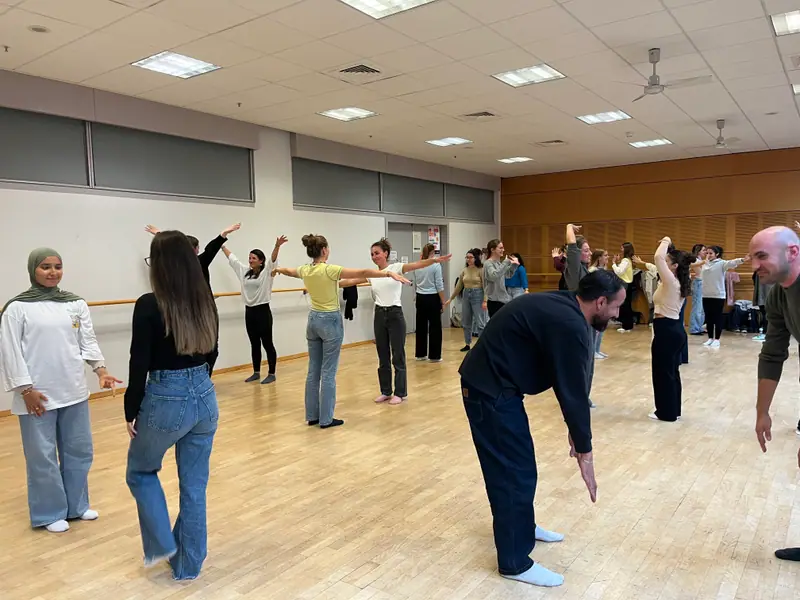
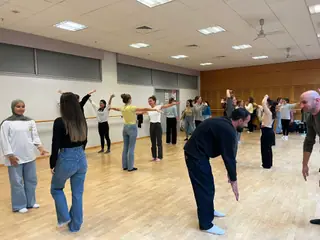
The course aims to raise awareness of the role of the body in teaching and learning and to explore activities that engage students’ bodies, using artistic approaches that can be applied in various contexts.


The course is primarily intended for students pursuing a career in elementary education. The student body is diverse and does not necessarily have a background in the arts.
Originally focused on pedagogy, the course was redesigned to integrate both cross-curricular and pedagogical dimensions, considering the teacher’s physicality to explore the role of the body in teaching and learning through arts-based activities. By addressing the teacher’s physicality, it becomes easier to grasp the challenges of teaching and learning through the body for students.
This change is based on recurring observations made during training and practicums. Students encounter difficulties related to professional demeanor (physical presence, eye contact, voice, movement, and spatial management) and have few opportunities to work on these aspects during their training.
The course thus aims to develop body awareness as a component of professional practice and to explore pedagogical situations that engage students physically, in arts education and in other learning contexts.
The course is based on an experiential approach. Students engage in activities that involve physical movement and then analyze how these experiences inform their teaching practice (how their own bodies respond, and how to encourage students’ bodies to respond). Sessions alternate between practical activities, group discussions, and theoretical concepts.
The first part of the semester is devoted to professional demeanor. Workshops on improvisation, movement, and vocal expression help students develop presence, eye contact, active listening, and coordination in interaction. Several sessions are led by a specialist in theatrical improvisation. Simple activities provide an accessible way to explore the relationship with the body, for example using everyday objects.
In a second phase, these experiences are linked to teaching situations. Students explore eye contact management, movement through space, and spatial organization as tools to support attention and interactions. Some activities involve reconfiguring the classroom space to encourage dialogue or cooperation or experimenting with ways of observing the environment from different perspectives.
The final part of the semester features activities based on artistic practices (shadow theater, activities inspired by dance, circus arts, or the visual arts). These activities help identify approaches that can be applied to arts education or other fields.
Assessment consists of two standard components. An individual analytical assignment focuses on a fieldwork situation related to the teacher’s body posture. A group assignment involves designing an eight-period arts sequence that integrates physicality as a starting point. The project is the subject of a written report (between 5 and 10 pages) and an oral presentation. The entire project is evaluated using rubric developed by the teacher.
The teacher points out that this type of course format requires suitable classrooms with ample space and easily movable furniture. The ability to quickly reconfigure the room is essential to accommodate physical activities and group work.
Student feedback has highlighted the importance of explicitly explaining the theoretical concepts underlying the activities. It is important that these activities be linked to more structured, theoretical sessions to introduce key concepts and theoretical frameworks.
Experiential and physical approaches can unsettle students who are unaccustomed to this type of format. Implementing them requires clear guidelines, with explicit objectives, precise instructions, and well-defined assessment criteria. A visible structure for the program helps reinforce its clarity and legitimacy in the eyes of students. It is essential to establish an atmosphere of trust and support so that students can participate without hesitation, and so that these workshops are meaningful for their future practice.
“I really enjoyed the few non-lecture-based classes; they’re a huge change from what we usually encounter at university, and I really enjoyed attending them (improv, pottery).” “The course is very diverse. We had few lectures, several workshops in the dance studio, and even a clay workshop. Also, the course content is closely tied to our practice, and by the end of the course, I have a much clearer understanding of the role that physicality plays in my teaching.” “I really appreciated the course structure as well as the emphasis on workshops. The clear organization of the sessions, alternating between theoretical input and practical workshops, allowed me to better understand the concepts covered and to experience them firsthand. The workshops fostered engagement, discussion, and greater body awareness, which made the course dynamic, coherent, and enjoyable to take.”
This teacher welcomes colleagues to observe their course. Learn more →
Same innovation type

Same innovation type
 UniNE
Same innovation type