

Same innovation type
Visual analysis
SDS
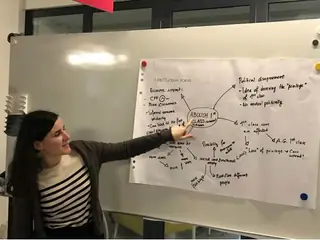
Participatory workshops encourage students to reflect on their consumption and mobility practices, share their experiences in groups and consider sustainable changes. They then write syntheses on supporting sustainable consumption initiatives based on case studies and collective discussions.

This course is given to six Master’s programs in the Faculty of Science. The objective is to raise students’ awareness of sustainability issues by addressing the concepts of consumption and social change.
The teacher’s intention was to be able to offer her students a theoretical part in order to fully understand the disciplinary concepts, but also a more practical part, despite the high number of students, to illustrate the concrete application of the theories discussed.
Project implementation
After a first part of theoretical course, the teacher set up 2 participative workshops, one on food consumption and the other on mobility as well as a group work on a sustainable development initiative.
During the workshops, students begin by completing an individual reflective exercise in which they will write a 2-page report on their own food consumption/mobility behaviors and practices over the course of a week. In the second part, the students will, in groups, be able to pool and compare the way they buy food or travel to see how their individual practice fits in with the collective. This individual questioning and these common reflections involve them more and allow them to question their practices by considering changes towards a more sustainable mode. In order to feed the reflections between the students, case studies are proposed in the flipped classroom by the teacher. On the basis of the case studies and their joint reflections, the students are led in groups to write summaries on how certain initiatives towards “sustainable consumption” can be supported by taking into account the material and social constraints identified.
For the group work, students are invited to apply a conceptual framework of social change learned in class to analyze and support an existing initiative (zero waste in Carouge, community garden, etc.). The deliverable is a written report, in addition to a literature review. Students are invited to be a force of proposal and to explore possible development paths based on urban planning policy.
The evaluation of students in continuous assessment is based on participatory workshops (40%), group work (50%) and course/lecture participation, including 2 external guests per semester (10%).
For this format to work well, it is important that students are clear on the theory before moving on to the practical part. They must work regularly and complete the required readings for the group assignments. In order to make students accountable for their learning, part of the evaluation is based on individual pre-course work and participation in the course.
To keep the course current, the workshop topics and resources are updated regularly.
Forming groups of students is always tricky, especially when they don’t know each other. Students who wish to work together have the possibility to do so, for the others, the groups are generated automatically. Due to the large number of students, the 1er workshop is divided into 2 sessions - with 2 moderators.
“The course provides an overview of theoretical approaches to issues of sustainable change and social change, while involving students via participation in discussions and workshops that link theory and practice.” “The lectures are well-structured, informative, and clearly communicate information. Slides include references to papers or sources for further learning. At the beginning of each class we are made aware of the specific concepts that we’ll be covering during that class and how we will tackle exploring these subjects. The assigned readings directly support learning from the lectures. Lots of examples are provided during the lecture to illustrate key concepts and theories. I also appreciate that the second homework assignment is an individual assignment, as this semester in all courses we have been overwhelmed with group projects and assignments.”
Same innovation type

Same innovation type

Same innovation type