


Same innovation type
Video Learning Lab
FPSE
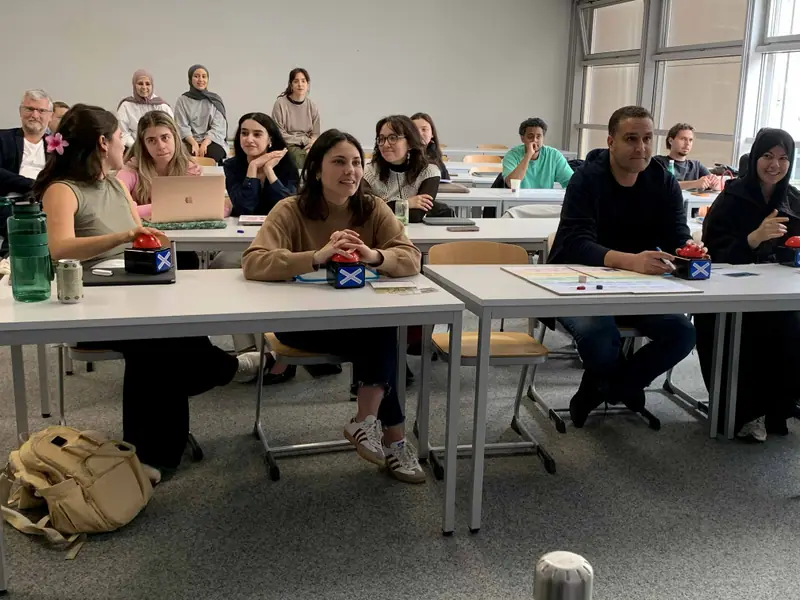
Teachers provide their students with learning experiences during each class session. These are directly linked to the didactic and pedagogical situations they will face as young professionals. The aim is to develop their cross-disciplinary skills, particularly in project management, by monitoring projects from “real” client.
This “Professionalization and Intervention” course is a Master’s-level course open to different study plans at the Faculty of Psychology and Educational Sciences (FAPSE). It aims to professionalize students by exposing them to the theories, practices and tools essential to their future careers in education and training.
For a long time, teacher was in a kind of “pedagogical illusion”. Every year, he added new tools and innovative teaching activities to encourage student participation and interactivity. What’s more, every year the student evaluations were excellent, giving the impression that this race to pedagogical innovation was having a major impact on learning.
The “disillusionment” began when the teacher introduced continuous assessment, questioning his students on the content they had seen beforehand. He was frustrated to find that, although the audience was captivated and evaluated the teaching positively, the learning was not! Students were forgetting an enormous amount of content over the course of the semester. Worse still, the students we met again in subsequent years had forgotten virtually everything and had reverted to their old beliefs.
Following this observation, the teacher sharply reduced the content transmitted in his teaching. The innovation he wishes to focus on from now on is experimentation. Behind each teaching objective, each activity, there is a professional questioning and a “practical” sense with the acquisition of new skills.
The entire course is now structured around a student-centered pedagogy. The teacher is constantly asking what the students are going to do during a session, while the “content” is secondary. It’s precisely these activities and experiments that students will remember in the long term, and from which the “theoretical” lessons will flow.
In concrete terms, this course is organized around two types of learning: specific skills and cross-disciplinary project management skills, the common thread running through the course.
One of the first pedagogical objectives of the course is to demonstrate the superiority of the visual sense over other senses in memorization. Rather than giving a long theoretical presentation on the subject, the teacher starts with a concrete professional problem: “How do you remember the first names of the students in a class?”. A session in the University’s video studio is used to memorize the first name of each student in the class, by overlaying an image related to the person’s first name on the green background. For example, if a student’s name is “Marc”, he’ll create an animation of himself shooting a bow and “arrow” (“arc” in french) at a target in a forest. The live demonstration helps his or her classmates to remember his or her first name in the long term, as they see their colleague shooting a bow and arrow, and this memory gives them a clue to remember the first name “Marc” in the long term. In their future professional lives, students will be able to reproduce this experience and apply this specific skill to memorize their pupils’ first names, using mental visualization.
Most sessions are structured around the realization of an authentic project. Each year, five projects are proposed by sponsors from the world of education and training (e.g. City of Geneva, Montbrillant College, EPFL, private companies, etc.). As their projects progress, students will work in groups to develop cross-disciplinary skills such as writing, presentation, use of Artificial Intelligence (AI) and time management. For example, around the concrete professional problem: “How to use AI in a project?”, a session at the University’s Faclab enables students to listen to the testimonial of a startup that resides there and uses AI on a daily basis. After the demo, students can directly test a paid version of ChatGPT to help them carry out their pre-project phase and generate infographics for their upcoming presentations.
Assessment takes the form of continuous assessment. Practically every week, groups of students are asked to submit a project deliverable in line with the pedagogical objectives of each course. There are four pre-project deliverables (2.25 pts) and four project-related deliverables (3.75 pts). These deliverables take the form of reports to be handed in, presentations to be made and the final work to be handed in, which can take a wide variety of forms (podcast, video, interactive presentation, website, etc.) depending on the skills within the group and the sponsor’s request. Over the course of the semester, each submission of one or more deliverables to the sponsor triggers a formative evaluation by the teaching staff, enabling students to improve their grades throughout the semester.
Bringing learning experiences to students requires a great deal of imagination and organizational time. For each session, you need to be ready to ask yourself questions about the most suitable place, people and materials. Then, each year, you have to find new resource people, check the availability of the chosen venues and borrowed equipment with your own course schedule.
In this case, coupling with the “project management” aspect adds novelty with the selected projects, but adds an extra mental burden. Each year, it is necessary to establish new partnerships and seek out new sponsors.
As with any pedagogical innovation, the teacher advises not to innovate “at all costs”. Every time we add something new, we need to think carefully about its relevance and meaning in terms of our pedagogical objectives. Trying to do too much and mixing too many innovations risks losing students.
This kind of course doesn’t happen overnight. The teacher’s advice is to gradually add a new learning experience each year and make sure it works.
In this pedagogical approach, the role of the teacher is completely overturned, and you have to step back and let the students take the lead. The introduction of continuous assessment ensures that they adopt this role.
The teacher becomes a resource person, accompanying students in their learning and adapting to their pace. Depending on the number of students, their background and prior skills, this pace can be very different, and you need to be ready to adapt. Formative assessment is time-consuming, but it helps to alleviate this difficulty. It’s particularly interesting to assess progress, not just the end result.
“The confrontation with the professional world and the presentation of project management tools are a real added value compared to other courses.” “The course ppt’s are very well done, the teacher masters the technology very well and uses it to good effect. The teacher tries to implement dynamic activities in class. The full-scale project (working with real principals) is motivating, and for those aiming for this kind of job in the future, it’s a good learning opportunity. The group work is relevant for sharing the substantial workload and reassuring fellow students in a project of this scale.” “The fact that the assessment concerns a real task is very motivating and interesting. I really enjoyed working on a project where we had a real principal with whom we had to interact to create a desired deliverable. Thank you for this rewarding format.” “Maybe say from the outset that it’s cross-disciplinary. In the sense that lectures practical thoughts are not separated. Some students are not ready for this type of format. Indeed, more traditional Geneva university teachers distinguish between lectures, practical classes and exercises. However, for me, the surprise allowed me to be playful, something that’s lacking everywhere.”
This teacher welcomes colleagues to observe their course. Learn more →
Same innovation type

Also uses AI

Same innovation type