

 1st prize 2026
Same innovation type
Designing an Escape Game
SDS
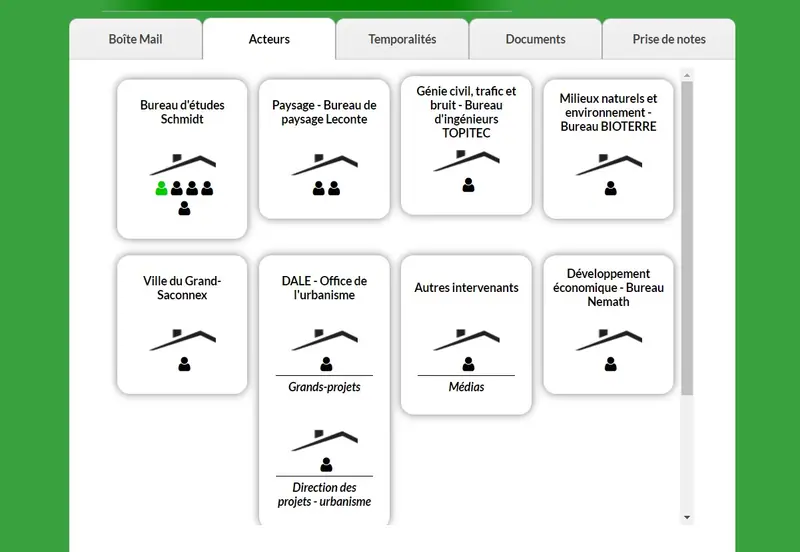
This course offers a serious game that simulates professional life in an urban planning office, offering students the opportunity to experience the stages of urban planning project management and make decisions impacting the scenario of the game, an experience difficult to reproduce in a real context of a project in class.


Over the last twenty years, the practice of urban planning has changed significantly. The conduct of an urban project is now similar to a complex project management requiring more and more skills in project engineering. Faced with this observation, the Master in Territorial Development at the University of Geneva was eager to adapt its teaching methods for the training of future urban planners and other planning agents. The choice was made to move towards problem-based learning and role-playing strategies by offering students a simulation (a teaching mode regularly used in the Faculty of Medicine) to foster a “knowledge to act” allowing to mobilize and combine a variety of knowledge, procedures and resources.
A fund obtained in 2017 made it possible to meet this expectation with the development of a serious game by the School of Engineering and Management of the Canton of Vaud (HEIG-VD) dedicated to the management of territorial development projects.
This serious game is a simulation of professional life in an urban planning office. Its use by the teaching team can be adapted according to the level of the students, the course format and the educational objectives.
In concrete terms, the student immersed in this simulation receives an email with the description of an urban planning project via the platform. From there, it is up to him/her to go and solicit the different actors of the game to collect various documents that will help him/her carry out his/her mission, which is marked by critical steps. Throughout the game, events occur week after week and the student is led to make choices and decisions that will have an impact on the scenario and the conduct of the project. For example, one can decide at the beginning to go and visit the site or choose to go there later. The possible actions at each stage of the project are limited by a time budget so, as in reality, it is not possible to do everything. It is therefore important for the student to think critically and allocate resources to the tasks that seem most important.
The temporality and the play of actors are realistic in this simulation, two elements that are very complicated to put in place in a real project presented in class. On the one hand, because an urban planning project can last for years and on the other hand, because there can be many actors involved (which makes it complicated to invite them all to testify during a course). In the framework of the urban planning project workshop, for example, students respond to a real request from a municipality or a canton. They are asked to produce a territorial diagnosis and then to propose a development project for a site. Within the framework of the partnership, the public authority commits to delegating people to follow the projects at the different key stages. At the same time, students can take advantage of the simulation game to experience all the steps of managing an urbanism project, which cannot be approached within the limits of a semester workshop.
tudents play the game in teams during reading week. Depending on the discussions that take place within the groups, the game time is 4 to 5 hours. An option in the game allows students to send feedback while they are playing. A debriefing by team is done during the session, the students relate the process, argue their decisions and get feedback from the teaching team. They have the opportunity to replay the game in order to explore and measure the impact of each decision on the rest of the game.
A serious game is a large-scale project. In addition to the financial cost of technical development, it takes a considerable amount of time to create the scenarios (about 50 pages). On the other hand, this simulation can become the central element of a course with theoretical contributions and educational activities that can be articulated around it.
The enormous added value of a serious game of this type is to be able to emulate an entire project for educational purposes. This allows students to have a holistic vision of the conduct of a project and allows them to reason and make decisions as close as possible to real professional situations. Students have the opportunity to put their theoretical knowledge into practice to develop professional skills.
Playing in groups stimulates reflective practice and peer learning. It is important to give feedback to students on their progress through the game and to give them the opportunity to play again to learn from their mistakes.
Students who have already had a foot in the professional world are the ones who have welcomed the serious game the most.
1st prize 2026 Same innovation type

Same innovation type

Same innovation type