


Same innovation type
Electronic portfolio
Médecine

To meet the challenge of early identification and support of students in difficulty, an institutional process involves teachers and academic advisors. Diagnostic interviews enable personalized learning plans to be drawn up, involving students and teachers in particular pedagogical stages.

Much research agrees that learners with serious academic difficulties, approximately 7-15% of students, are identified far too late in training programs. Most teachers, because of their expertise, can identify the presence of potential difficulties in a learner. However, this perception, although mostly relevant, remains very global and intuitive, and is not really followed by targeted and personalized support measures.
Consequently, one of the major challenges in supporting and monitoring students who are experiencing difficulties in acquiring their skills is to intervene quickly. This targeted and concerted intervention must allow for the development of learning plans tailored to the specific difficulties of the student. It is also important to involve and support teachers to homogenize and legitimize their pedagogical support actions. To do this, it is necessary to have an established institutional process, a defined conceptual framework, and precise and targeted pedagogical methods and tools.
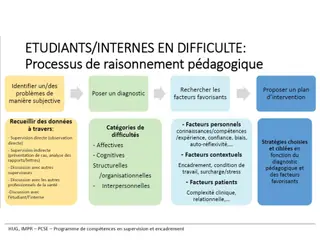
Identification or reporting of a student in difficulty to the student support group can be made from a variety of sources: academic advisers, teachers or supervisors, students themselves, indicators in the student electronic portfolio, examination results, placement assessments.
The student concerned is then contacted to arrange an interview. The interview allows an initial diagnosis to be made and categories of difficulties to be determined, including affective, cognitive, structural/organizational, and interpersonal.
The monitoring and support group proposes a solution with a targeted learning plan to develop skills according to the pedagogical diagnosis. The implementation of the plan is followed by a pedagogical contract signed by both parties.
Some pedagogical steps, established in the contract, are delegated to supervisors and teachers in the context of the placement. Sometimes supervisors are also mandated to act as pedagogical advisors in the longer term.
Same innovation type

Same innovation type

Same innovation type