


Same innovation type
Resolving human rights issues with companies
GSEM
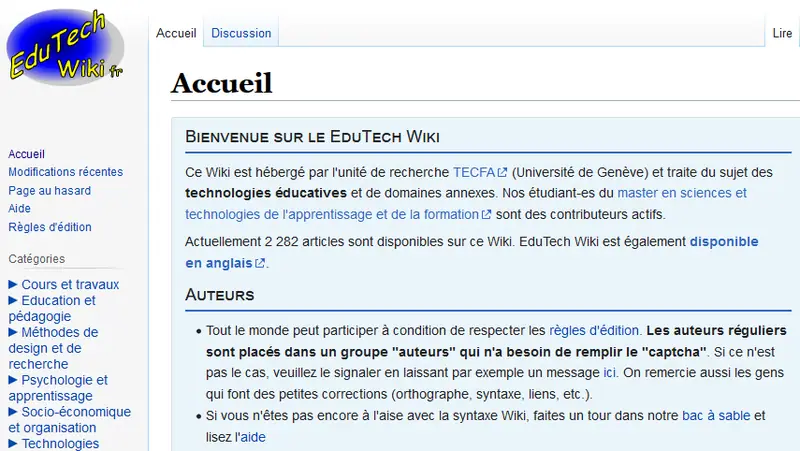
The "STIC I" course is based on project-based pedagogy: students design interactive devices to solve learning problems and contribute to the EduTech Wiki.
The course “Information and Communication Sciences and Technologies I (ICST I)” is a compulsory course of the Master MALTT (Master of Science in Learning and Teaching Technologies). Delivered for more than 20 years, this programming course was until 2015 focused on the Adobe Flash tool, it is now oriented on the web technologies of HTML5, CSS and JavaScript.
The teaching team has developed a course material that is open to all on the web, participative and evolving. All the teaching material of the course is gathered on the Wiki “EduTech Wiki: Computational Thinking with JavaScript”. Since 2006, this university Wiki is hosted and administered by the team of TECFA (Technologies de Formation et Apprentissage), an academic unit within the Faculty of Psychology and Educational Sciences (FPSE).
The Master MALTT is a hybrid training, its program alternates one week of intensive classroom training and 4-5 weeks of independent work at a distance. The ” STIC I” course takes advantage of this alternation by relying on the “problem-solution-sharing” approach.
During the distance learning periods, the course includes the creation of 6 different projects. Each time, students design and develop an interactive device (e.g., video with javascript, drag and drop, interactive map) that “solves” a freely chosen learning problem. On the other hand, technical constraints are imposed in order to mobilize specific computational skills (creation of a random element, use of a control structure, etc.). Each skill is presented on an EduTech Wiki page with detailed information and concrete application examples.
Once the device is designed, learners deploy it on a freely accessible web server and accompany the device with a report that explains the objectives, design and main steps in production. This documentation allows interested parties to understand the development of the project and possibly adapt it to their own needs.
In parallel, students are expected to contribute to the EduTech Wiki. The teaching team would like students to contribute directly to the improvement of the course content according to a “write to learn” pedagogical approach.
The 6 devices are graded using a detailed evaluation grid available in advance. This is returned to the students after the exercise with feedback for each evaluation criterion.
The competency-based approach coupled with the project-based approach allows the teaching team to ensure that all the competencies targeted by the course are acquired and motivates the students. They will choose relevant themes and develop devices that correspond to their personal and/or professional needs.
The course has found a good balance between synchronous sessions and autonomous distance work after two years of transition. This transition period was also devoted to the development and adjustment of resources to the targeted competencies.
The implementation of such a course is time consuming. However, the availability of the pedagogical material on a public Wiki type site guarantees at the same time the durability of the resources and the transversality to other contexts (e.g., the P-8 project ‘Reinforcement of digital skills in teaching’, Computational Thinking in Social Sciences).
“The course provides a good foundation in programming and computational thinking.” “Although my skills are still limited, the difference between my level in September and my level in February is immense. I learned HTML, CSS, the basics of JavaScript, how to use a server, how to contribute to a Wiki, and how to develop useful and functional applications in a few months.” “Understand the differences and usefulness of different languages, use their features for educational purposes.” “More than learning, I have strengthened my computer skills, especially when it comes to programming in JavaScript and coding in HTML/CSS.” “Having only skimmed JavaScript and other languages, I was able to learn a lot more about the power of the language. I learned how to do video editing, albeit very basic. I learned a bit more about the different licenses and the use of libraries.”
Same innovation type

Same innovation type

Same innovation type