

Same innovation type
EcoSlam
SDS
In this course, students learn to combine text and image to stage their vision of the world through media such as comics, photo-novels, or collage.


This course is at the intersection of visual studies, political geography and cultural geography. It proposes to show how the political geography of the world, at different scales, is staged and imaged in popular culture. Through the study of media such as comics and film, students will discover how a geographic space, process or object is represented. Previously, students worked with existing comic books (reportage comics), but the teacher believes that the best way to understand a medium is to experiment with it. Therefore, she now suggests that the rendering for this course be in the form of a comic book.
This course is divided into two parts. In the first part, students approach the subject from the perspective of cinema by practicing film analysis (see corresponding project). In the second part, they learn to combine text and image to stage their experience of the world.
During the 1ère session, the teacher presents the theoretical concepts allowing to deconstruct what a comic book is, following the previous reading of articles by the students at home. The next two sessions were led by professionals: one by a former student who had done his thesis in comic format and came back to share his experience, and the other by an Italian researcher and artist who had done a thesis in geography on comics. During these sessions, apart from these presentations by professionals, the students are invited to familiarize themselves with drawing, to let off steam in front of this unusual medium of expression. The teacher takes the opportunity to insist on the fact that it is not artistic skills that will be evaluated, but the ability to appropriate a new medium to exercise and stage one’s individual view of the world.
The project is then built with the teacher who proposes a general theme each year (e.g., the theme of displacement, crossing borders, etc.) and validates the adequacy of the students’ project proposals, if possible autobiographical, with this theme. For example, this year a student chose the theme of confinement to think about the exploration, she approaches the story of her mother’s life who lived through the war in Lebanon in relation to confinement. The next step is to explore with the teacher how to link the chosen topic with visual representations or drawings. The productions must combine text and image (comic strip, photo novel, collage, etc.) of at least 5 pages in A3 format. This rendering must be accompanied by a 2-page reflective file on the exercise and presenting the state of the art, the methodology and the bibliography of their project.
Half of the course evaluation is based on the film analysis done in the first part of the course and the other half on the individual written work and the comic book produced. The students understand quite quickly that the evaluation of the second part does not concern their artistic traits, but rather their ability to play the game. The teacher evaluates the acquisition of practical/methodological tools, the capacity to mobilize in a coherent way the articulation between texts/images and the reflexivity/relevance of the remarks. The students have at their disposal the evaluation grid and criteria for the comic strip and the written report.
The teacher insists on the fact that in such a project, it is necessary to know how to surround oneself with credible and competent professionals and to clearly identify the role that one will play.
She also stresses that it is important to reassure students that their artistic skills are not the issue, because often their first reaction is to say that they can’t draw. Whatever medium they choose (drawing, photography, photojournalism), it is important that they take ownership of it. To do this, it is necessary to dedicate sessions to the practice and appropriation of the medium.
This type of format allows students who are not very good at writing to express themselves and sometimes reveal themselves through a different medium. In addition to the technical skills that students cannot fully acquire in 4 sessions, they learn to work with a visual through a particular medium.
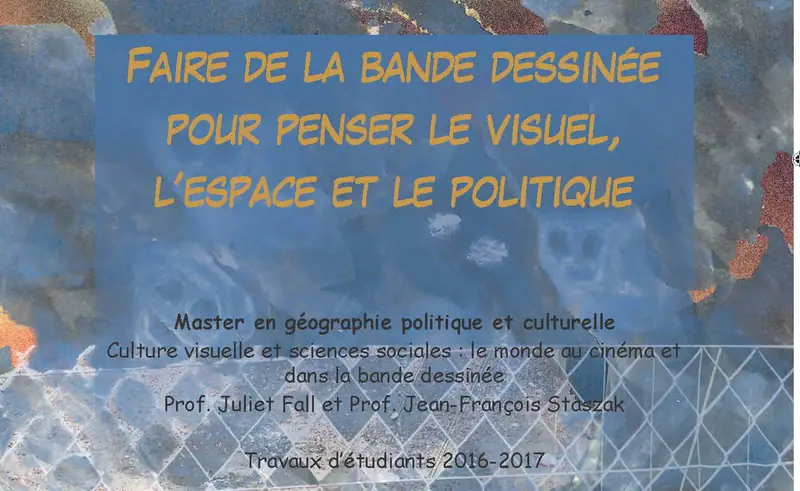
The teacher believes that it is important to value the students’ productions. If they play the game well, it is necessary to make the effort to value it. To do this, she would like to publish a book with all the students’ work from the past two years. For the moment, those of the year 2016 have been gathered in the form of a university brochure.
The teacher reports that she recently published a paper in comic book form, a sign that comics have their place in the scientific world. On the other hand, one of her colleagues recently submitted his thesis in comic book format.
“I find this class very interesting. I also enjoy working on my own comic book, as well as the analysis of the exploration film.” “The small number of students allows for real interaction and quality exchanges directly with the teacher.” “A new approach to social science that is interesting and necessary, with moments dedicated to practice (which is rare and valuable).”
Same innovation type
Same innovation type

Same innovation type