



Same innovation type
Start-up Training
Transversal
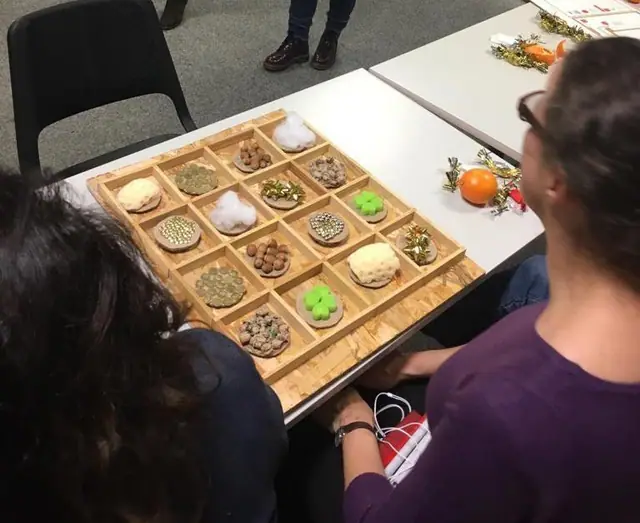
Students participate in two interactive activities with visually impaired people: during the "shared visits", they accompany them on cultural outings to discover everyday reality, during the "creation of prototypes" they design innovative adaptations of everyday objects to improve their accessibility.
The course “Psychology of visual impairment in children and adults” is part of a new Master’s program entitled “Psycho-educational approaches and situations of disability”, which is common to students in the Psychology and Educational Sciences sections. The objective of this course is to better understand the psychological, perceptual and motor development of people with visual impairments.
During the first edition of this course in 2018, the students expressed the wish to have less theory and more practical application. As a result, the teacher set up “applied activities” in order to establish links between academic / empirical knowledge and the development of professionalization aspects in the approach to disability.
The pedagogical device is centered around 2 applied activities during which the students are in contact with visually impaired people.
The first activity, “shared visits”, consists of making one or two cultural visits with a visually impaired person. The students, divided into pairs, are responsible for finding and contacting a visually impaired person and determining with him or her an activity of interest (a visit to a museum, a movie, a meal at a restaurant, an excursion to a castle, an escape game, etc.). Following this experience, students will write a report (2 points) and prepare an oral presentation (1 point) during which they will have the opportunity to share their experience and make links with the theoretical contributions of the course (from the locomotion of the visually impaired person to his or her way of apprehending works of art and explaining his or her aesthetic emotions). The students’ presentations will fuel the discussions and the search for devices to be put in place on a daily basis to improve the quality of life of visually impaired people.
The alternative proposed to the students to the shared visit is the writing of a written synthesis (2 points) of several researches of a theme related to the course and its presentation (1 point).
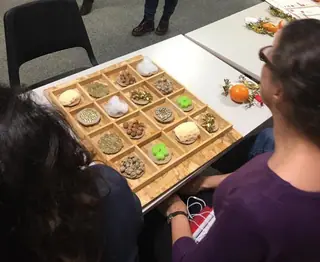
The second activity, “creating a prototype”, consists of selecting an element / product of everyday life to adapt it to visually impaired people. The students, divided into small multidisciplinary groups (psychology and education sciences), will propose prototypes of books, games, resources, etc. Each project must be original and innovative. Each project must be original and innovative in order to be validated by the teacher. The prototypes are pre-tested with a visually impaired person (often those on shared visits) and then presented to a jury of professionals during the final sessions, highlighting the theoretical basis for the choices made (materials, representation techniques, etc.). Time was set aside during each session to allow students to work in sub-groups on their prototypes under the supervision of the teacher, who answered their questions and gave them advice on fabrication. Apart from the time set aside for the sessions, the students are free to organize themselves as they wish. Here are a few examples of prototypes that have been created: a tactile-illustrated album on the seasons for young children, an adaptation of the game “loup-garou”, a memory game, Uno, Puissance 4, a tactile map to get around the UniMail library.
The results of this project are very positive, because it allows students to better make the link between theoretical knowledge and field observations. It also allows to experiment the way in which theoretical knowledge can help to make prototypes adapted in a relevant way with regard to the psychological functioning of visually impaired people.
On the student side, the motivation to get involved is strengthened because the interventions and projects have a direct use beyond the course. The quality of some of the book and game prototypes was widely praised by the professionals. On the side of the visually impaired, the students’ visits and their projects are highly anticipated and appreciated.
In order to set up this learning method, the teacher called upon his network, visual impairment being one of his research themes. The fact that the prototypes are actually evaluated by experts in the field and by the target audience is an important added value.
” Lot of practice and not just theoretical content. ” ” People concerned with the problem of visual impairment who came. ” ” Shared visits that allowed us to get a reality check on the accommodations that are in place for people with visual impairments, but also the many challenges they face on a daily basis. ” ” The design of the prototype that pushed us to think, especially by asking questions about the choice of equipment so that it is the most suitable for people with visual impairment.” “It is very interesting that we are offered concrete field activities, thanks to the outings to be organized with people who have a DV. It is also very exciting to make a prototype. This project allows us to complete our awareness of DV, but also to invest in a concrete project. The interventions of an expert and people with DV were very stimulating and concrete as well.” “However, this course is severely lacking in structure. This lack of organization even de-secured me in taking the shared visit orals and demotivated me to diligently take this course at the end of the semester. There was no clear schedule. The lack of respect for the one stated at the beginning of the semester without readjusting it realistically in a strong and timely manner has hurt my appreciation of this course. This is a pity because despite the very disorganized structure, there is a lot of potential in the outline of this course structure. Moreover, it lacked theoretical input. We had only two theoretical lectures given by M Gentaz during the whole semester. At times he gave the impression that he was not very invested in his role as a teacher. He would pop in at the beginning of the course and delegate the teaching to others and then leave. Sometimes he doesn’t teach the whole class, he has to be somewhere else.” “The course is very interesting, unfortunately the poor organization and structuring of the course takes away from the interest. The workload: visit + report + prototype is really heavy I think. We spent a lot of time on it a list of people to contact for the visits would be really good, it avoids research time, not obvious.”
Same innovation type

Same innovation type

Same innovation type