

Same innovation type
Short film
SDS
This course explores the concept of "voice politics" through interactions and audio creations, with an emphasis on the issue of representativeness in political and academic communities. Students form groups to create audio essays based on oral presentations.
The master’s seminar on “critical theories of race” and postcoloniality completes the existing offer in political theory, by focusing on non-eurocentric critical approaches. This unique course in western Switzerland on these themes and approaches has been taken by students from all over western Switzerland since its launch in 2016.
Originally, the pedagogical device of this seminar was organized around a conceptual thread around the concepts of “power” and “subject”. Presentations and discussions of theoretical texts, divided into thematic chapters, led to the writing of essays to evaluate the acquired knowledge. This rather traditional arrangement did not sufficiently encourage learners’ reflexivity. Beginning in the fall of 2020, the teacher reoriented the seminar around the theme of “voice” in both form and content.
The new pedagogical framework implemented echoes the theoretical material of the seminar (which the teacher conceptualizes by the notion of the “politics of voice”) with different forms and spaces of knowledge production. The seminar of 6 ECTS credits takes place over one semester at a frequency of 2 hours per week. An additional 2 hours of study every other week offers a series of workshops either on writing or on working with sound.
From a substantive perspective, voice is a central concept to the theories taught, questioning how and why some voices matter less in political and academic communities marked by race and (post)coloniality. Voice is also the central tool that students are called upon to exercise through multiple moments of interaction that culminate in the creation, in small groups of 3-4, of a ten-minute audio essay.
During the workshops, the teacher exercises the voice in an interactive way. The students must create work groups by taking charge of the presentation of a theoretical corpus. Each group must make an oral presentation during a session. In addition, each week, each student posts a question on Moodle about the texts or audio-visual materials provided by the teacher, so that the question can be discussed in the next session.
To allow students to theorize through voice, small groups are formed and evaluated on the development of a podcast-type audio essay that builds on and extends the oral presentation made during the seminar. Each group produces a podcast script and delivers a first version during a dedicated colloquium. This listening colloquium emphasizes peer coaching. Each group is assigned to produce a critical feedback on an essay by their colleagues, which allows them to practice their reflexivity. To accomplish this, the teacher provides a detailed guide for creating podcasts.
Sessions are devoted to writing the script, recording the voices and editing the podcast with open source software (Audacity). These sessions are led by external contributors (notably by a producer/director of an independent radio show and by an artist who produces sound, or by a rapper and an actor for the issue of voice acting). The teacher and guest speakers help improve the students’ work and give advice. Students use their own materials, the idea being to value less institutional forms of learning, which follow the spirit of “Do it yourself” or popular pedagogy. It is also about showing that it is possible to do quality with little means.
All the feedbacks allow the groups to create a final version of their podcast. This podcast is completed with a presentation file and gives rise to a final qualitative evaluation (Yes/No) detailed in an evaluation grid. This objective evaluation of the student’s knowledge pushes them to put into practice the issues raised by the theories of the seminar.
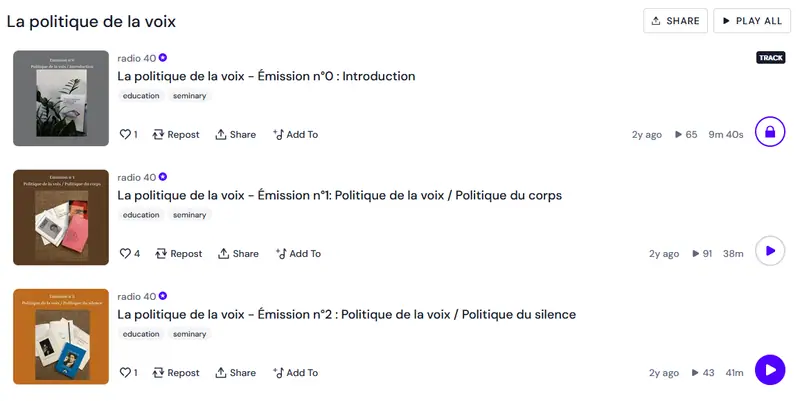
The corpus of mandatory theoretical texts is diversified thanks to the inclusion of “non-academic” materials (podcasts, music, videos, film excerpts); students are invited to enrich this corpus through a forum provided for this purpose on Moodle. The core texts are available to students, but also to the general public in the form of free booklets thanks to a partnership with the independent bookstore La Dispersion, which allows this knowledge, which is the result of the resistance of oppressed and under-represented groups at the University, to be circulated outside its walls. Finally, the knowledge produced during the seminar is broadcasted on the online radio Radio 40, accessible for free to any interested public.
For the teacher, it is important to maintain a resonance between the content and the form. Thus, depending on the theme, the partners and external contributors may change if the theme evolves. The media used may also change. What is important is that the media be used to serve the theme being addressed.
In order to better prepare the students for the difficulty of the content, which is not always popular, on their ability to theorize and on the way they work, the teacher has fleshed out the framework of the different stages and workshops for the 2021 edition. Despite the students’ often limited knowledge of the corpus taught, the teacher was able to observe the students’ learning in part on their ability to problematize the theory and to ask more and more precise and constructed questions as the course progressed. The teacher also makes a point of encouraging students to think about the skills they already have (outside of the university setting in particular) but also about the experiences they can mobilize and put to use in the seminar.
The teacher recommends a number of 3 to 4 people per group to generate creativity and active discussions. The use of open source tools is also a deliberate choice to make knowledge available and to remain in a dynamic of sharing and open dissemination. Moreover, the podcasts produced can also be reused as course material depending on the theme studied and as an example for a first digestion of the course corpus.
With a little extra money, the teacher was able to bring in an actor and a female rapper for the 2021 edition to provide additional coaching on voice placement, which significantly improved the clarity and tone of the learners when listening to the audio essays. She also organized a technical and creative office that allowed learners to consult with some of the external speakers on specific issues they were struggling with.
In order to promote the work done by the groups and to continue to value the texts studied, the teacher proposed during the following semester a research internship to master’s students who had previously taken the course. One of the dimensions of this internship was mainly to create a communication campaign promoting the student podcasts via the Instagram account linked to the course. The communication campaign is available via the Instagram account: The Politics of Voice.
The teacher recommends that the management team be trained in project-based learning and soft skills in collaboration with the Teaching and Learning Support team.
“There is no course that I have ever attended with such pleasure. The topics covered allow me to engage with issues that mobilize me, both in my academic work and in my personal commitments. The hybrid format is particularly stimulating: even when I’m not feeling up to it, I’m obliged to participate and I always come out of the course having learned something. By pushing us to be active all the time, we retain the concepts more. The creative rendering format allows me to step out of my comfort zone. I really surprised myself by being so involved in the production of the audio essay. Themes, energy, rendering format, I think this is exactly what I was looking for when I went back to school, thank you.” “The teacher manages to synthesize the themes very well and brings in playful ways the topics and issues covered.” “The evaluation model allows us to work on the course concepts while pushing us to be creative.” “The discussion in each class, the participatory aspect. Extremely interesting. And again this is the only course at Unige specifically for critical theories of postcoloniality. The modes of evaluation are different from what we’re used to, which is extremely rewarding.” “The multiple assessment modalities, while representing a large workload, are varied and very consistent with the course content (politics of voice > podcast). They allow for an immersion in the concepts and a reappropriation of the theories studied and encourage a creativity rarely mobilized in a “classic” academic course.” “We really like this format and it’s a real change from other courses and seminars. It is very enriching to be able to experiment with our voices and to use the skills and interests of the different people in the group. Afterwards, it’s a lot of work and I don’t think we expected such a heavy workload.” “I thank Noemi Michel for this course and also for her availability. She spends a lot of time accompanying us, answering our questions, proposing interactive exercises to value the exchange and the pleasure of learning. I really enjoyed participating in this course with such an imaginative teacher who is constantly looking for other innovative ways to teach. This is a course format that has left a lasting impression on me!” “Some of the texts are very dense and difficult to read. But at the same time they are fundamentals so I understand the reading choices.” “The course seems hardly suitable for distance learning (discussion, oral presentation, debates, question and answer exercise).” “Very good workshops, which gradually set the stage for the audio essay. The speakers were all very interesting and made us aware of the different dimensions we should pay attention to in the realization of audio essays.”
Same innovation type

Same innovation type
 Award
Award Same innovation type