


Same innovation type
Interactivity in the amphitheatre
GSEM
During the sessions, teachers encourage student interaction and participation by using tools such as Mentimeter to ask questions live. In addition, optional formative quizzes are offered to students after the preliminary readings, allowing them to self-assess and strengthen their understanding of the topics covered.
Following a program reform aiming at introducing courses in pharmaceutical sciences from the 1ère year, the teachers had to develop a new course for 180 students. This reform concerns the universities of Neuchâtel, Lausanne and Geneva which are, for this 1ère year Bachelor’s course, grouped together in Lausanne for the face-to-face courses, limiting the grouped courses to 4 hours given face-to-face and 2 hours given by distance learning. It was therefore necessary to adapt the course content to this new format.
During the 2 hours of distance learning, the teachers propose different activities to the students. Most frequently, students are given exercises and problem solving exercises to do at home. Due to a lack of assistants, the teachers do not have enough time to offer a personalized correction to these exercises, but propose a detailed correction online. They also make themselves available by email or in class to answer specific questions from students.
In a flipped classroom format, students may be asked to read a course summary during these 2 hours covering all the content covered during the following 4 hours of classroom instruction. Students have optional quizzes available on Moodle following these readings to self-assess their understanding of the article (see appendix). These quizzes remain available for the duration of the semester, so students can retake them at will to practice. The availability of pedagogical resources before the course allows teachers to go more quickly through their lectures and to go into more detail on certain notions that are not understood by the students. In order to test the students’ knowledge during the course, the teachers use Mentimeter, an online survey application that allows them to ask different types of questions live to the students.
The course is evaluated by a written exam at the end of the semester. Previously, it consisted of exercises and problem solving in paper format. This format was very time consuming in terms of correction. The teachers’ desire to keep the problem solving led them to design a mixed format. They now offer problem solving requiring 2 or 3 steps of calculations leading to a MCQ with only one correct answer. The correction is made easier since the teachers do not judge the development of the calculations, but only the answers to the MCQ.
Teachers note that Mentimeter is easy to access and relatively smooth. The free version is sufficient to prepare surveys with different types of questions. They suggest, when posting the questions to the students, that they answer them themselves (even with wrong answers), because they have observed a group effect during these activities: a few posted answers will encourage general participation.
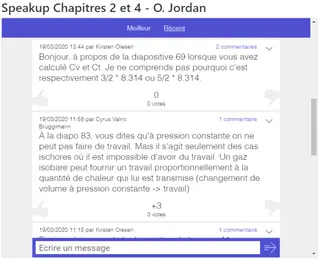
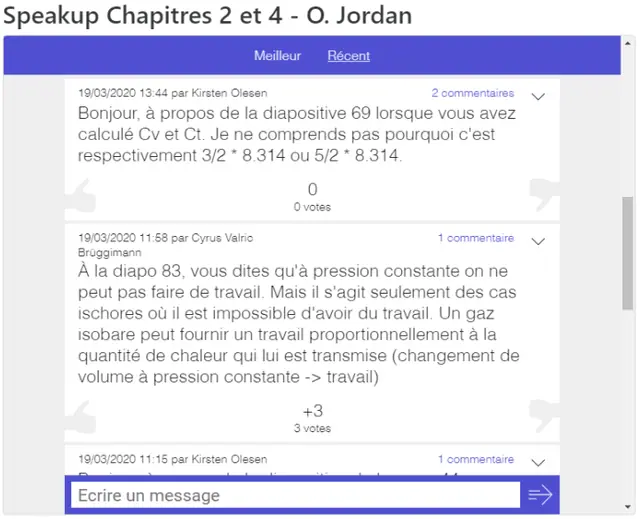
The teachers also tested SpeakUp, a platform allowing students to ask their own questions about the course. However, under the cover of anonymity, some students took advantage of the tool to launch informal and sometimes deviant discussions. Faced with this problem, the teachers now use this platform by integrating it into Moodle so that student contributions are nominative. Through a “like” system similar to that of a social network, the platform makes it possible to know very quickly which student questions are the most relevant for the whole group.
Same innovation type

Same innovation type

Same focus