


Same innovation type
Learning and memory
FPSE
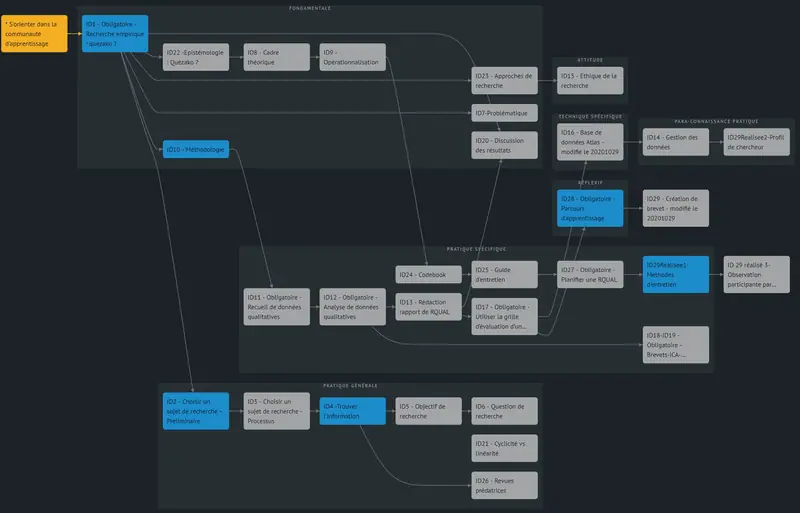
This course has adopted a project-based pedagogy since 2014, using the Sqily techno-pedagogical environment to encourage the development of skills and knowledge through thirty activities visually represented in the form of a tree structure allowing students to organize their learning path in a coherent way.

In the framework of the MALTT course, which is given in a hybrid format (one week in the classroom followed by four weeks at a distance), the student body is very varied, made up of young students with a bachelor’s degree, but also students who already have a master’s degree or a PhD. To consider these specificities and the skills and knowledge already present, the teaching team has been working with a project-based pedagogy since 2014. In 2020, it chose to implement it in the Sqily environment.
Developed at the Haute École Pédagogique (HEP) in Lausanne, Sqily is a techno-pedagogical environment that relies on knowledge trees and allows a learning community to develop skills and knowledge according to the principle of mutual validation through various activities.
Implementation and progress of the project
To make students work on theoretical, practical, and transversal knowledge and skills with a real research project, the teaching team has chosen to articulate the proposed activities around the threshold concepts identified in the literature on research methodology. These are: argumentation, theoretical approaches and frameworks, knowledge creation, data analysis and interpretation and research paradigms.
The teaching team used Moodle in addition to Sqily for the organization and monitoring of activities. Moodle was only used for the regulatory part of the course, including grades. The activities are grouped by category (technical skills, fundamental knowledge, etc.) and visually represented in a tree structure. Students therefore have a complete view of the research activities, their links and can choose, week by week, those they wish to carry out. About thirty activities have been designed and visually represented to allow learners to start with the activity that suits them best and to organize their learning path in a coherent way. Of the 30 or so activities, 8 are compulsory and relate to core skills and knowledge, the others are optional.
The flexibility of navigation in the learning pathway makes it possible to accommodate the diversity of learner profiles, particularly in terms of their skills. Each student can thus go at his/her own pace and develop his/her skills according to his/her own prerequisites and agenda. Sqily also makes it possible to indicate the learners who are resources for their peers on a given activity, to make available, week after week, the contributions of all to capitalize on the productions already made and feedback received. It also allows each student to have a metacognitive vision of the knowledge acquired and those to be acquired, and to be part of a wider model of the circular economy of knowledge by valorizing the knowledge of the community.
On the teaching staff side, the platform enables the individual progress of each student to be monitored. An email system and notification settings are integrated into the tool. The teaching team can therefore contact the student directly about a given activity and a specific task. The teaching team gives detailed feedback on each activity every week and grades the compulsory activities. It remains alert and motivated as this format means that a variation of assessments and feedbacks are to be carried out each week.
Assessment of the module is in the form of continuous assessment. The summative assessment takes into account the marks for the compulsory activities as well as the possible bonus from the optional activities. The formative evaluation is done week after week by giving feedback within 3 days of the activity.
Although the course can be run on Moodle, the teaching team preferred the Sqily tool for the pedagogical values it conveys knowledge trees and mutual learning. The former allows to visualise briefly the different possible trajectories and the latter supports social learning within a group.
Understanding learning in this way has required a complete rethinking of training and the roles of the different stakeholders. The learner is responsible for the choice of his/her learning pathway and carries it out according to existing skills and knowledge on the one hand and future interests on the other.
“The openness and availability of the teaching staff and the plurality of aspects of qualitative methodology addressed.” “The richness of the documentation and the creative approach.” “The way we work: by IDs and the thoughts written.” “Clear explanations, a desire from Barbara Class to help us progress, to help us understand, to interest us. A great availability too. Autonomy in the choice of patents and the course.” “The course is clear and well organized.” “Personally, I liked the tree structure between the different Sqily IDs.”[ID refers to activity identifiers, called “patents” in Sqily terminology] “Thank you for this discovery of qualitative methodology. I found this course challenging, but I come away wanting to continue learning.” In the areas for improvement, students noted: “The value of the types of data to be manipulated (focus on topics of interest to students).” “The way we give instructions in the different platforms we use.”
Same innovation type

Same innovation type

Same innovation type