


Same innovation type
Group Wiki
FTI
The instructor uses an academic coaching approach, encouraging students to take charge of their learning and fostering critical thinking and reflection in small groups. Assessment is done on a computer with access to research tools, simulating real working conditions.


The aim was to move away from the traditional lecture format in order to make teaching more dynamic, motivate students and help them become more autonomous in their learning. To do so, the instructor wanted to experiment with group work and peer feedback.
Students are afraid of failing and of not obtaining the course credits, which holds back their learning. At the start of the academic year, some are indeed more motivated to find a strategy for obtaining the minimum grade than to take a genuine interest in the course content. The instructor therefore wanted to find a way to spark a real desire to learn. The course includes individual work on intrinsic personal motivation, to stimulate participation and encourage students’ involvement both in and outside class.
First, the instructor provides a “Frequently asked questions” document that lays the foundations of the course and its format. Following the principles of academic coaching, she leads students to formulate their own learning objectives within the course. She encourages them to leave the role of mere consumers and become actors in their university path. To this end, students sign a learning contract. Then, regularly during the course, she pushes them to develop their critical thinking about learning, but also about personal development. In particular, she regularly encourages meta-reflection. The aim is to focus on oneself, one’s personal progress and one’s own learning, in an atmosphere of mutual trust and non-judgement.
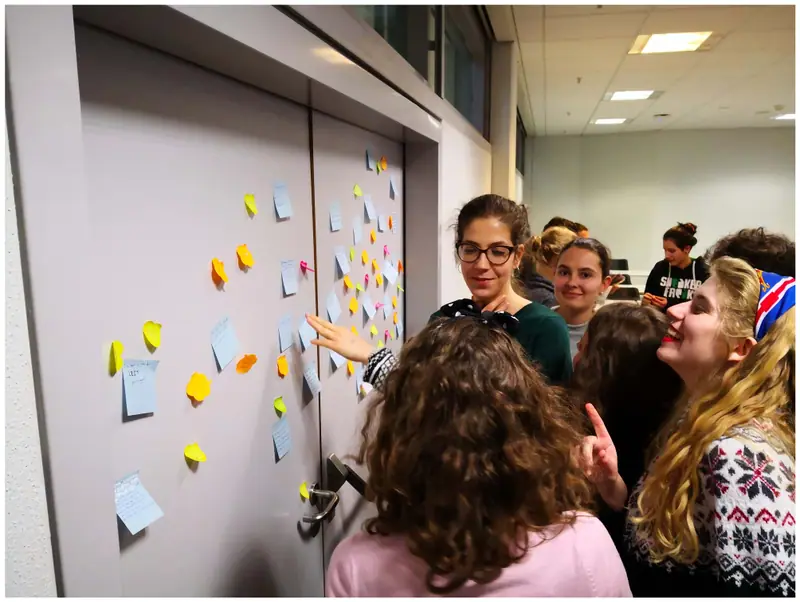
The structure of each session is in principle fixed, although it can be adapted to the students’ needs. This gives them a framework and a sense of stability that help build trust. Some exercises are sometimes dropped if most students find them useless. Following the flipped classroom model, students come to class having done some reading, a translation and a revision of a translation based on a question grid. They are also asked to write down one or more points they personally want to raise. The class often begins with a short activity (multiple-choice quiz, reading, sight translation) carried out independently, which lets the first arrivals get straight into the subject. Students then form groups of 3-4 to reflect on translation issues, based on the work done at home and on the question grid prepared by the instructor. They compare their solutions, enrich each other’s thinking, critique their proposals and develop new ones. In translation, as in the humanities, there is never only one possible answer. The goal is therefore to give students tools for reflection, develop their critical thinking, feed their curiosity and thus motivate them to go further. The small groups are not fixed: they are reshuffled every week, at random or according to the specific needs of the session. A whole-class feedback then allows the instructor to go back over one or two key questions, and students are invited to speak up at any time. As a general conclusion, the instructor often asks students for very brief feedback (sometimes a single word) on the course content, in the manner of the “One Minute Paper”. This lets her “take the temperature”, build cohesion within the class and give students a chance to look back on what they have learned. She regularly shares anecdotes from her own professional practice to stimulate them and spark their interest.
The assessment format (a translation) is also innovative. It is done on a computer, with more or less restricted access to research tools and the internet depending on whether it is a seminar assignment or the end-of-semester exam. This format strengthens the consistency and authenticity between exam conditions and real working conditions (e.g. aptitude tests taken as part of a recruitment process).
For the sake of fairness and consistency, the instructor makes herself available, notably by offering a weekly office hour. She stresses how necessary it is to be motivated oneself, flexible, and able to adapt to the work objectives brought by the students. The instructor adopts a stance in which she does not directly answer questions but stimulates individual and small-group reflection. Everyone must be able to develop their own answers and learn to support them. To carry out a teaching project of this kind, one must above all know how to ask the right questions, be open-minded, and not be afraid to question oneself and one’s teaching practices often, which is extremely rewarding on a personal level.
“The sessions are well structured; the small-group reflection and the debriefing with the suggested translation support learning. Not correcting sentence by sentence helps us step back from the text and target the real translation problems while avoiding calques.” “In my opinion the teaching methods are excellent. I learn a lot not only from the instructor but also from my classmates during group work. The texts we translate are always extremely varied: they deal with various topics, are of different lengths, require more or less research, etc. This lets us ‘try a bit of everything’. I am personally ‘against’ the ‘sentence-by-sentence correction’ method. Not that it is bad, but it has its limits. Thanks to this course’s method, I have the opportunity to reflect much more deeply on translation and to constantly question myself. I have even come to ‘like’ making mistakes, because it enriches me enormously intellectually. I also always enjoy explaining my translation problems. I find it a very relevant and extremely useful exercise.” “The course is extremely dynamic. The group work is motivating. The French quizzes we sometimes do are very interesting. I really appreciate that the difficulty of the texts increased gradually, so we could ease into it. I also really appreciate that we focused so much on translation problems rather than comprehension problems, because in my view a translation course is much more instructive if we learn to translate rather than to decipher an excessively difficult text.” “I really love the structure of the course. Working in small groups made me discover the power of collective intelligence, and the small sheets designed to guide us help me ask myself the right questions, without being told directly what is right or wrong. I think this is the right technique to help us progress. Revising my translations is also an exercise that helps me improve. Too often in the past, I set aside translations corrected in class without asking myself any further questions. The seminar assignment was, in my opinion, a success. It made us realise what a translator’s real working conditions are.”
Same innovation type

Same innovation type

Same innovation type