


Same innovation type
Sensor design Game
Sciences
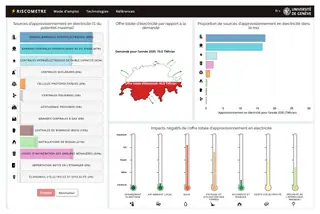
This course on the energy mix provides students with fact sheets and an interactive tool to explore electricity supply technologies and create an electricity mix for Switzerland in 2035, thus promoting informed reflection on the subject.
This course focuses on the different types of energy. It covers the energy, environmental and economic impacts of various electricity supply technologies in Switzerland, such as solar photovoltaic, hydro, wind, and nuclear power. A particularly complex issue addressed in this course is the electricity mix. The teacher wanted to make this subject, which includes about ten variables (e.g. technological constraints and several environmental or economic impacts), more accessible.
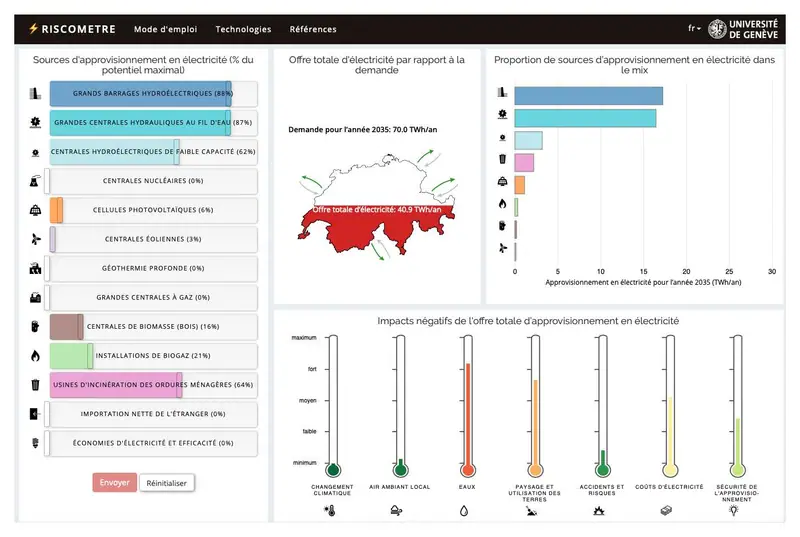
To this end, she provided students with simplified technical sheets presenting all the technologies illustrated by images. In addition to purely technical knowledge, the teacher was also interested in the students’ subjective opinions and judgements about these technologies. In order to involve them, the students carry out simulations on an interactive tool, developed by the teaching team during a research project: Riskmeter.
Project implementation
To enable them to discover the wealth of information that the energy mix represents, students are provided with fact sheets that summarize the main electricity supply technologies and their impacts. They are required to read through these before coming to the lecture, during which further explanations are provided. Following a theoretical introduction, the teacher engages in group discussions so that students can share what they have understood and exchange views on the different technologies.
Following these discussions, to put their knowledge into practice, students use the interactive tool Riskmeter. Individually, they have to create a technically feasible electricity mix for Switzerland in 2035. This mix must not only be feasible, but it must also correspond to the student’s personal values (emphasis on ecological and economic impacts). Through this exercise, students experience the advantages and disadvantages of different electricity supply technologies and form an informed opinion on the type of electricity mix they would like to see in Switzerland in the future. Following these simulations, further group discussions are held in which each student must be able to defend the choices he/she has made (which implies knowledge of all the possibilities and their different impacts). Students’ opinions are measured before and after the course to highlight the effects of their learning, e.g., changes in opinion due to new information learned during the course.
In 2019, the teacher offered students the opportunity to take the course materials (fact sheets and interactive tool) and adapt them for presentation to external audiences. Two students, as part of their master’s project, took up the structure of the course in a more in-depth and popularized way with the aim of offering it to different audiences. For example, they presented 4 information workshops for the citizens of Geneva. They also adapted their workshop material to the level of students aged 12 to 19 years to integrate it into the Terrascope activity at the UNIGE. In addition to their dissertation, these projects resulted in a publication in a peer-reviewed research journal. The students were thus able to consolidate the knowledge learned in class and transform it into a project that will be taught to audiences outside the university.
The Riskmeter tool greatly facilitates student learning. On the one hand, it allows them to experiment with the choice of technologies by knowing their different impacts, but it also facilitates exchanges after these simulations. It increases the motivation of the students, who particularly appreciate it, but also facilitates group discussions.
Being able to test one’s theoretical knowledge helps to make the course more digestible and fun. There are many interactive simulation tools that can be adapted to the different contents taught. However, if the necessary tool does not exist, one should be aware that the process of creating such a tool is time-consuming. Technical sheets are easier to create.
Offering students, the opportunity to appropriate course material for delivery to external audiences maximizes the learning effects and societal impact of students. It is a concept that can be adapted to all types of content. However, the teacher emphasized that she felt that it was more relevant for courses dealing with societal issues (sustainable development, health, digitalization, etc.). It is a very formative exercise to manage to popularize content. It is different from working on a subject for an exam and working on it to be able to teach it. It requires more motivation, integration of the content, and allows for the acquisition of many generic skills (project management, organization of workshops, public speaking, fundraising, etc.). In the long term, one could imagine a more institutionalized activity of this type, such as periodic educational events for citizens or formal links with schools where University of Geneva Master students would pass on their knowledge.
“It was really interesting to have all this information and to compare our opinion to the others. “It was a very interesting workshop. Interesting to see the current electricity system and try to find the solutions and mix needed for the future. I did not know Switzerland relied so little on electricity from a fossil fuel source. And I learn that there is not one solution for the future but we need to use a variety of sources and have an integrated system that can respond to demands when for example the supply of wind and solar are low.” “I really enjoyed this workshop. It was interesting to learn more about the impacts of all different types of energy, especially to learn that some of the energies we think of as the most sustainable do also have negative impacts. It was a useful exercise to try to do the task ourselves of working out Switzerland’s future energy supply. Thank you!”
Same innovation type
Same innovation type

Same innovation type