


Same innovation type
InteractLab
FPSE
This course on cooperative pedagogy offers interactive and hands-on activities to deepen the principles of cooperative learning. Students prepare activity planning, receive formative team feedback, and participate in group discussions to improve their co-operative education skills.


This course aims to train future primary teachers in cooperative pedagogy. Research shows a gap between the benefits of this pedagogy and the lack of implementation in the classroom. The teacher therefore decided to implement pedagogical devices that would allow students to apply the pedagogical principles that are the content of the course. However, from about 20 students in 2017 and 2018, the number of students enrolled has increased to 60 for the fall 2019 semester. This increase has required some adjustments by the instructor.
Project implementation
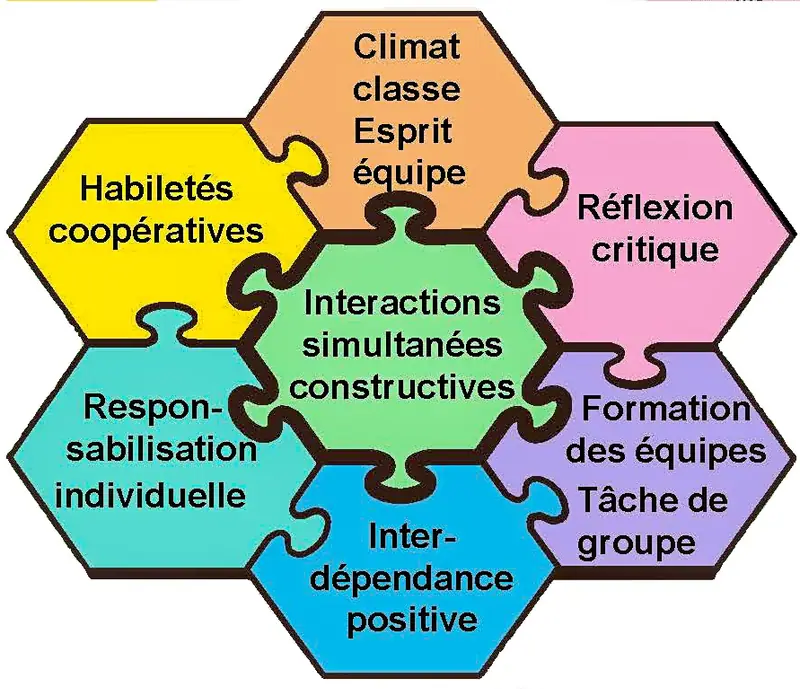
This course takes place over 4 days (8:30am-4pm) spread out over the semester and alternates contributions, interactions and group discussions (see the presentation document). During these 4 days, the 7 pedagogical principles of cooperative learning are approached through activities allowing to deepen the studied principle in a concrete way. Students are led to reflect on the role of interactions between students to support learning while being put in a situation. Students experiment with cooperative activities in order to appropriate the principles to prepare students to cooperate and organize work in teams so that they can plan school activities themselves. Peer discussions are organized to make each student active through cooperative structures.
Before each class (except the first one), students must prepare an activity that mobilizes the pedagogical principles taught in the previous class (students can choose whether or not to implement it during their internship). Previously, at the beginning of the course, each student presented his or her planning to the class and received feedback from the other students and the teacher. From now on, such a presentation accompanied by individual feedback on the plans is no longer possible because it is too time-consuming. If the beginning of the session is still devoted to informal feedback and exchanges on the plans, it is now done in groups of 3 or 4 with feedback from peers. The teacher remains available and circulates in the groups to answer questions from the teams.
These formative feedbacks in teams are a place for exchange, regulation and improvement of individual planning. The teams are formed either randomly during session 2 and 3, or chosen by the students during the last session. For the latter organization, the teacher suggests that the students present their plans in the form of a “commercial” in a maximum of one minute in order to show the diversity of the plans and to allow the students to choose their team according to the points they wish to develop. During the team feedback, the interactions between students are structured so that everyone can think and speak calmly in the teams and benefit from constructive exchanges on the contents. The teacher arranged the instructions in such a way as to make the students more responsible and to support the quality of peer-to-peer regulation. Thus, when a student presents his/her planning in a team, the others listen and give feedback. They take responsibility for checking the specific criteria for which they are responsible for providing accurate formative feedback on the planning. Since the evaluation instructions are provided at the beginning of the course, each student knows the work expected and the criteria by which it will be evaluated. The discussion allows students to take ownership of the evaluation criteria when giving feedback and to improve their planning based on the feedback received. These formative team feedbacks are followed by a 15-minute group question and answer session.
During these collective discussions, students are informed by the teacher that each of them may be called upon to present what was discussed as a team (reinforces engagement in team discussions). A playful draw system allows all students to be asked to contribute to the collective construction (reinforces engagement in collective discussions). This draw is made thanks to an online tool representing a wheel composed of all the students’ first names. The teacher specifies that each student must be able to contribute something different from the one brought by the previous student.
The large number of students also led the teacher to change the presentation of more difficult theoretical principles to elicit students’ questions. Students are now asked to read the articles about this content before class and write down their questions. In the team question and answer activity, students provide answers to each other. In order to limit the number of questions to be dealt with collectively, they must choose one common question per group for each topic and enter it on the Padlet platform.
The validation of the course is done on the basis of an individual file (see instructions) which includes the planning of an activity (8 pages maximum) and a reflexive assessment of the findings and learnings concerning cooperative pedagogy (1 page). Previously, each of the 3 plans prepared before the course dealt with a separate activity. Once these were reworked according to the feedback received during the session, they constituted, along with the assessment, the written file to be handed in to validate the course. From now on, the plans can, throughout the semester, cover different activities, but will have to be rethought since the final dossier must cover only one activity using all 7 principles studied. This new format sometimes requires students to rearrange the chosen activity from one session to the next so that it lends itself to the integration of all the principles.
Thoughts and advice on implementing a similar project
The high number of students and the full-day time frame increase the risk of dropping out. With the proposed activities, the teacher mobilizes the students more in the construction of the contributions in group. Students are more engaged in team discussions because they are informed that each of them may be asked to present what has been discussed.
The teacher insists on the fact that these devices for making students active, identifying their needs and empowering them in their learning and that of other students are transferable to other contexts and other content.
“I find it exciting how this course is run. I find that the fact that you actually experience during the session what is advocated theoretically in this same course is really very telling.” “The teacher’s attentiveness when we have questions and the various work modalities that make the course more interactive and dynamic.” “The fact that we do cooperative type exercises ourselves which thus allow us to realize the constraints” “The courses are well structured and the fact that we often change the way we work allows for better participation and attention. I also find that the course gives us a lot of leads and that I feel better equipped to set up cooperative activities in my future practice, because we are given plenty of examples. “I thank you for this great course, which has already served me several times during my internship and which I am sure will serve me throughout my professional life. “To begin with, I would like to say that I was surprised by the format of this course. Being used to ex cathedra courses where the professor explained the material in a frontal and unilateral way with, at times, practical exercises, I did not expect a course with more than 60 students where we would have to work with each other. I was therefore forced to actively engage cognitively and socially in the work proposed by the teacher, being in a group with other students whom I often did not know and who were also willing to work (without being able to get lost in my thoughts). […] The surprise and curiosity of some of the practical aspects of the course (grouping, structures, etc.) allowed me to see this university course with an interested eye. I take positive note of the group interactions. I was able to collaborate with people I had never worked with before (forming groups based on affinity) this allowed me to encounter new ways of looking at teaching and experience interesting exchanges.”
Same innovation type

Same innovation type

Same innovation type